
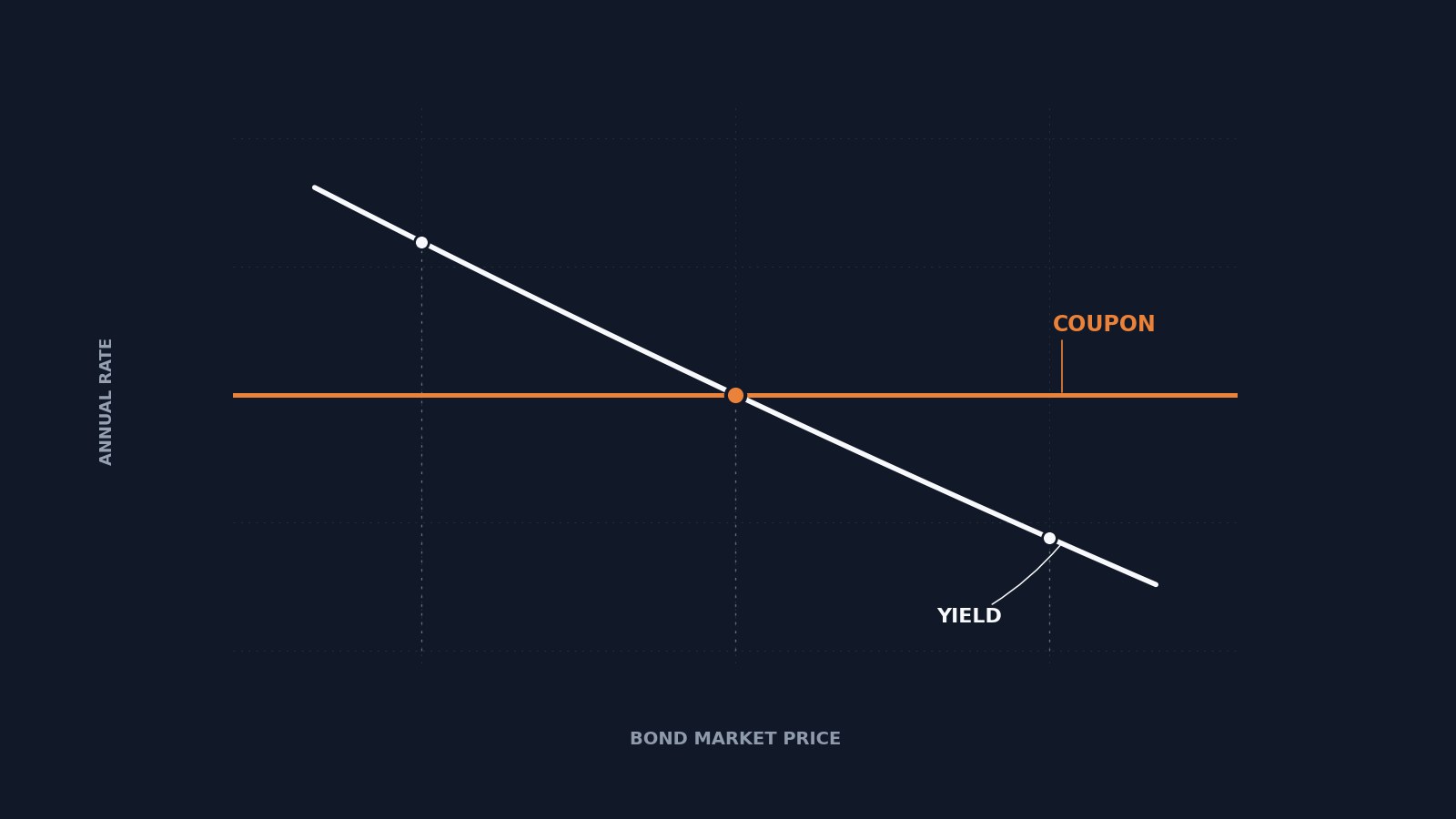
The coupon is fixed when the bond is issued and generally reflects market conditions at issuance. The yield reflects the return implied by the bond's market price at the relevant pricing date.
The distinction matters for transfer pricing because the relevant market observation is generally the yield at the pricing date, aligned with the tested period, rather than the coupon set at issuance.
A bond has promised payments and a market price
Consider a bond with a face value of $100, a five-year maturity and a 5% annual coupon. The issuer promises to pay $5 of interest each year and to repay the $100 principal at maturity. The 5% coupon determines the contractual interest payment, and it does not change when the bond is subsequently traded.
After issuance, bonds can be bought and sold in the secondary market. A bond's market price represents the amount an investor must pay today to receive its remaining interest and principal payments, and it may fluctuate in response to changes in interest rates, the issuer's credit risk, time to maturity, liquidity and other bond-specific characteristics.
In simple terms, a bond's terms determine its future payments, while market conditions determine how much those payments are worth today.
Why bond prices affect the investor's return
Returning to our earlier example, consider the same bond, which pays an annual coupon of $5 and repays $100 face value in five years:
| Market price | Yield to maturity |
|---|---|
| $95 | 6.19% |
| $100 | 5.00% |
| $105 | 3.88% |
Simplified example assuming annual coupon payments.
The bond offers the same coupon payments in all three cases. What changes is the price investors pay to receive them.
An investor who purchases the bond for $95 receives the annual coupon payments and earns an additional $5 when the bond repays $100 at maturity. By contrast, an investor who pays $105 receives the same coupon payments but incurs a $5 loss on the principal repayment.
As a result, the bond has a higher implied return, or yield to maturity (“YTM”) when purchased at a lower price, and a lower YTM when purchased at a higher price.
This illustrates a fundamental principle of bond valuation: bond prices and yields move in opposite directions. It also explains why a bond's coupon rate alone does not determine the return investors can earn at current market prices.
Coupon, YTM and YTW answer different questions
The coupon tells us the bond's contractual interest payment. In this example, it is 5% of the bond's $100 face value, or $5 annually.
The yield to maturity, or YTM, converts the bond's current price and all remaining payments into a single annualized return. If the bond is purchased for $105 and repays its principal in five years, its YTM is approximately 3.88%. YTM is not an additional payment made by the issuer. It is a standardized way of expressing the return implied by the bond's price and remaining cash flows.
Some bonds allow the issuer to repay the principal before the scheduled maturity date. These are known as callable bonds. Suppose our bond can be called after two years at its $100 face value. If that happens, the investor receives only two annual coupon payments and incurs the $5 difference between the $105 purchase price and the $100 principal repayment sooner. The return in that scenario is approximately 2.41%.
The yield to worst, or YTW, is the lowest yield among the bond's permitted repayment scenarios, assuming the issuer makes all the required payments. In this example, YTW is 2.41%, compared with a YTM of 3.88%.
“Worst” does not mean that the issuer defaults. It refers to the lowest contractual yield if the bond is repaid as permitted under its terms. For a bond with no early-repayment features, YTW and YTM are equal.
Which measure is relevant for transfer pricing benchmarking?
When bond data are used to benchmark an intercompany loan, the objective is to observe the return required by the market at the relevant pricing date. The coupon may have been established years earlier and may reflect market conditions at issuance.
The yield is more informative because it incorporates the bond's current market price, its remaining interest and principal payments, and the time over which those payments are expected to be received.
This is also what makes a traded bond a relevant market reference for a loan priced today. The bond may have been issued years ago, but its yield at the pricing date is a current observation: it reflects the return the market requires, on that date, for the remaining cash flows of an issuer with that credit profile.
The same logic applies to term. A ten-year bond issued five years ago has approximately five years of remaining maturity today. For term-matching purposes, remaining maturity—not original maturity—is the relevant measure.
For option-free bonds, YTM provides the natural return metric. For bonds with embedded options (such as callable bonds), YTW must be used to evaluate the impact of potential early repayment.
From bond yields to an arm's-length range
An observed bond yield does not automatically represent an arm's-length interest rate for an intercompany loan. Its relevance depends on the comparability of the underlying financial instruments and their economic characteristics.
A bond-based benchmarking analysis generally involves:
- Accurately delineating the intercompany loan.
- Identifying potentially comparable bonds based on credit risk, currency, remaining maturity, seniority, security, repayment structure, liquidity, and other relevant economic characteristics.
- Observing their market prices and yields at the relevant pricing date.
- Evaluating any remaining material differences refining the comparable set, testing alternative assumptions and making reliable adjustments where supported by the available data.
Bond yields translate observable market prices and disclosed cash flows into current market returns, providing transparent evidence to which informed transfer pricing judgment can be applied.